




Executives at South Bow Corp. say customers have been clamouring to ship more oil on the southern leg of its pipeline network.
Richard Prior, South Bow’s chief operating officer, says recent geopolitical turmoil has driven an increase in demand for more oil exports, including via the U.S. Gulf Coast.
South Bow operates the Keystone system that runs from eastern Alberta to refineries in the Midwest and the Texas coast.
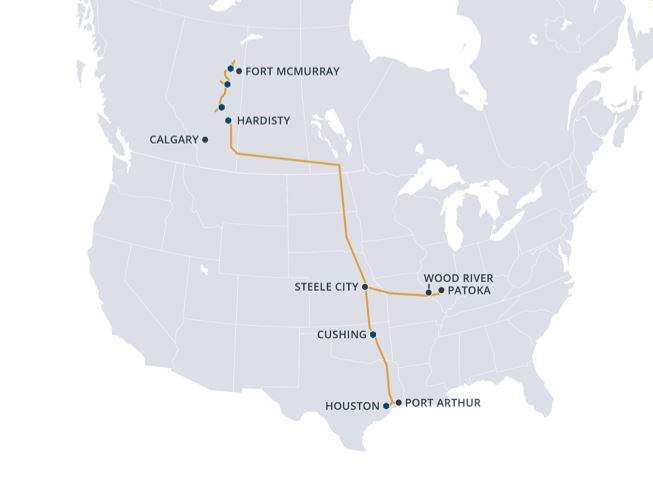
Calgary-based South Bow Corp. operates approximately 4,900 kiolometres of pipelines from Alberta to the U.S. Gulf Coast.
Source: SouthBow.com
Average throughput on Keystone during the first three months of 2026 was 616,000 barrels per day, with the U.S. Gulf Coast segment averaging about 709,000 barrels a day.
Prior says the Gulf Coast leg of Keystone can move more than 800,000 barrels per day, but there is limited ability to grow capacity much further beyond that level.

South Bow is in the midst of weighing bids for a potential new project called Prairie Connector, which would ship oilsands crude to the Canada-U.S. border and onto U.S. destinations.

Get weekly money news
Get expert insights, Q&A on markets, housing, inflation, and personal finance information delivered to you every Saturday.
Prairie Connector could use dormant pipe that had been meant for the defunct Keystone XL expansion project, which was scuttled amid intense environmental and political opposition several years ago.
Keystone XL was pursued by TC Energy Corp., which spun off its oil pipeline business to form South Bow in 2024.
U.S. President Donald Trump recently granted a permit to a separate proposal by Bridger Pipeline LLC linking Wyoming to the Canada-
U.S. border. That pipeline could link up with Prairie Connector.
This represents a meaningful development in the permitting process for cross-border energy infrastructure and one that has understandably attracted its fair share of attention,” said South Bow CEO Bevin Wirzba.
“That said, we are continuing to work diligently to ensure any project we advance is within our risk preferences and that risks are allocated appropriately among the parties best positioned to manage and mitigate them.”
As far as what form a potential partnership might take, Wirzba said, “We’re still baking the cake on a few elements of that.”
To be comfortable making a final investment decision on Prairie Connector, it would have to nail down the “typical elements” like its contracting strategy, supply chain, procurement and cost estimates, Wirzba said.
But it doesn’t end there.
“We need to ensure that we manage and mitigate any last-mile risk that could occur on the project in the future,” Wirzba said.
“We’re seeing great alignment among the regulatory environment in both Canada and the United States, but we cannot expose our shareholders to risks that they cannot bear, nor can we.”
Late Thursday, South Bow posted first-quarter net income of US$77 million, down from US$88 million during the same period of 2025.
The profit amounted to 37 cents US per share versus a year-earlier 42 cents US.
South Bow, which keeps its books in U.S. dollars, reported its revenue fell to US$491 million from US$498 million.

© 2026 The Canadian Press