



CLEVELAND — Two hard facts hover over this year’s midterm races in Ohio.
Subscribe to read this story ad-free
Get unlimited access to ad-free articles and exclusive content.


It has been 20 years since the state last elected a Democrat as governor. And it has been even longer since a Democrat not named Sherrod Brown has won a second election to any nonjudicial statewide office.
But party leaders are daring to be optimistic in 2026, encouraged by polls that show their candidate for governor, physician Amy Acton, running close with newly official Republican nominee Vivek Ramaswamy. They also scored a recruiting win when Brown launched a comeback Senate bid. Brown won the Democratic nomination Tuesday to face Sen. Jon Husted, the Republican appointed to succeed Vice President JD Vance. Early polls foreshadow a close race in that contest, too.

“It just feels like Ohio is back,” said state Democratic Party Chair Kathleen Clyde, referring to years in wilderness when, except when Brown was on the ballot, both national parties retreated from what was once a fiercely contested battleground.
Alex Triantafilou, the Ohio GOP chair, acknowledged a tough political climate for Republicans this year. President Donald Trump’s job approval ratings have fallen to new lows as he takes the rap for an unpopular war in Iran and rising gas prices that have accelerated frustrations with the economy.
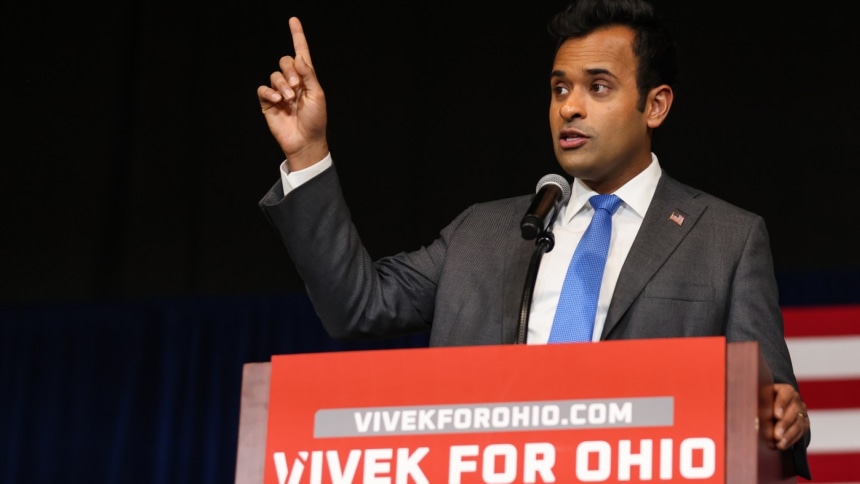
“Cautiously optimistic,” Triantafilou replied when he was asked how he feels about his party’s chances this fall. “We recognize the challenge of any midterm when you’re in power. Our challenge is to turn out our voters. If we do that, we’ll win just like we did in ’24 and every year before.”
Just like when Ohio regularly decided presidential elections in past years, its 2026 races have national importance. While the Husted-Brown race could play a role in deciding who controls the Senate next year, several battleground House races could do the same in that tightly divided chamber. And the governorship is a huge prize drawing attention, too.
An early ad blitz in the governor’s race
Ramaswamy’s candidacy could make Trump an even bigger factor in the governor’s race. The two became close after Ramaswamy ended a 2024 presidential bid that was never overly antagonistic toward Trump.
After he worked with billionaire Elon Musk to establish Trump’s cost-cutting Department of Government Efficiency, Ramaswamy, a Cincinnati native who lives near Columbus, returned from Washington to launch his campaign. Trump promptly endorsed him, and the Ohio Republican Party soon followed suit.
“He’s not on the ballot,” Clyde said of Trump. “But his harmful policies certainly are, and Republican candidates up and down the ballot are going to have to answer for his harmful policies, whether it’s tariffs that have raised costs of food and groceries and goods on Ohioans, whether it be his reckless war with Iran that has caused our gas prices to be up over $5 a gallon.”
In some ways Acton represents retiring Republican Gov. Mike DeWine’s legacy, having been his health director when the Covid pandemic hit. A rare Democrat serving in the GOP administration, she quickly became a household name. But she resigned in June 2020, citing a desire to spend more time with her family.

Her decision came after protesters, some of them reportedly wielding guns and signs with antisemitic messages, demonstrated outside the Statehouse in Columbus and her home in a nearby suburb. Acton, who is Jewish, later expressed concern that, had she stayed in the job, she would have been asked to sign harmful health orders at a time when DeWine was under political pressure to reopen the state.
“You’ve got a far superior candidate with a far superior campaign going against a very flawed candidate who has been known to tuck her tail and run when the going gets tough,” said Jai Chabria, Ramaswamy’s chief strategist. “It’s been well-documented that she really doesn’t have the stomach for this.”
While Acton emphasizes that she grew up poor in Youngstown and lived a difficult childhood, Ramaswamy’s campaign and allies plan to remind voters of her role advising DeWine through stay-at-home orders and business closures.
One ad, part of an initial $10 billion blitz planned by Ramaswamy’s campaign, accuses Acton of postponing Ohio’s March 2020 primary in the midst of Covid. DeWine, who backs Ramaswamy, has taken issue with the spot, asserting that Acton acted on his order.
A rush to define the other
Democrats have homed in on Ramaswamy’s wealth, flagging that often he travels the state in a private jet and highlighting a New York Times interview in which he called affordability a “buzzword.”
They often cite a podcast on which Ramaswamy, prompted by host Ezra Klein, said he believed that Medicare and Medicaid were — “with the benefit of retrospect” — mistakes. Acton and her allies also have reveled in Ramaswamy’s eagerness to pitch or embrace disruptive policy ideas, such as hefty property tax rollbacks and a consolidation of state colleges and universities.
“Dr. Amy Acton is running for governor to lower costs for Ohioans, tackle the corruption in our statehouse, and to fix our public schools,” Acton spokesperson Addie Bullock said. “While Vivek Ramaswamy flies over Ohio in his private jet, telling us that affordability is just a ‘buzzword,’ Dr. Acton is laser focused on building a state where all of us can thrive.”
Acton had no primary opponent. Ramaswamy faced a challenge from Casey Putsch — a YouTuber and political novice whose insults about Ramaswamy’s Indian American heritage were a calling card — and barely veiled concerns about how his race and Hindu faith would play in Ohio. When Ramaswamy introduced state Senate President Rob McColley as his running mate for lieutenant governor, fellow Republicans pointedly praised him for choosing a Christian.
Ramaswamy is using his financial advantage to gradually introduce himself and his ideas to voters, though Democrats have noted that the first TV spots his campaign aired showed him sparingly.
“Vivek’s campaign consultants and strategists know the same thing that we do, and that’s that Ohio doesn’t like Vivek Ramaswamy,” said Justin Barasky, an Acton adviser. “And they have to figure out how to get him elected without allowing people to hear him talk.”
While Acton and Ramaswamy each raised $5 million from donors in the most recent fundraising period, Ramaswamy last month kicked in $25 million from his personal fortune — most likely ensuring that this year’s race for governor will be the costliest in state history. As of late April, Ramaswamy’s campaign had six times as much cash as Acton’s did. Her campaign has yet to hit the airwaves, instead pushing to earn coverage by flooding social media with posts and clips it believes reflect poorly on Ramaswamy.
Chabria, the Ramaswamy strategist, laughed off the approach.
“If the Democrats win on Reddit,” he said, “I’m very comfortable.”
“The Democrats for the last 15 years have had a lot of false bravado — a lot of people that they get excited about — but they don’t really know how to close it out,” he added. “I think this is going to be another case of that.”
On the comeback trail
By comparison, the Senate race between Brown and Husted has been quieter — so far.
Brown, who lost to Republican car dealer Bernie Moreno by 4 points in a year that Trump won Ohio by 11, has been reintroducing himself to voters. Husted has been trying to carve out an identity for himself as a senator, focusing on issues on which he hopes to lead, such as AI. But a lack of a primary on the Republican side — a rarity in recent Senate races here — had kept the contest on a lower flame than the election for governor.
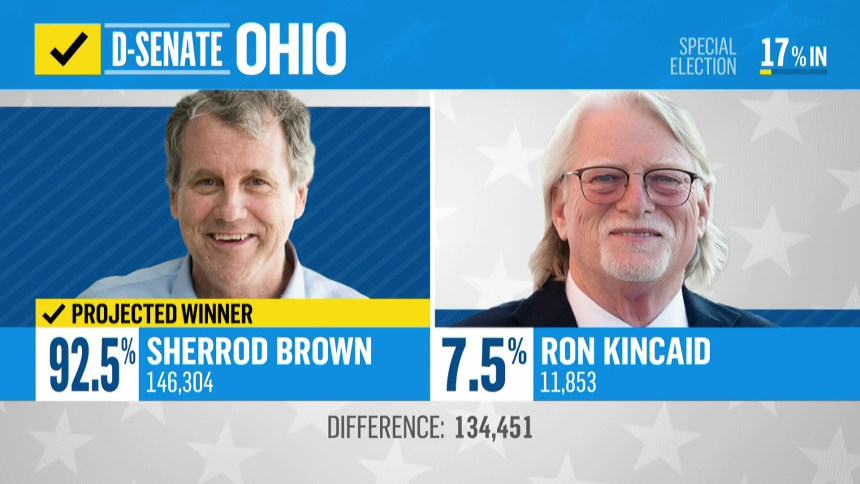
That began to change last week, when Husted and Brown both hit the airwaves. Husted’s 30-second spot opens on a biographical note before it asserts his commitment to job growth. Brown’s ad focuses on money Husted’s campaigns received over the years from associates of Jeffrey Epstein, the late sex offender.
This race, too, will be expensive. Brown’s campaign had $17 million in the bank as of mid-April — more than double Husted’s $8.1 million. But outside money is likely to pour into the state and give Husted cover, much like it did for Moreno in 2024.
In a memo outlining how they see the state of the race, Husted campaign officials said their candidate “is in the unique position of appealing to MAGA Republicans, moderates, and even blue-collar union voters.”
The memo also asserts that Brown “must pitch a perfect game” to prevail and emphasized that he had lost union support and “struggled to keep his base together as Democrats see working class voters abandoning them in droves.”
Beyond the Epstein-related attack, Brown and the Democrats are finding fodder in Husted’s public remarks, including a recent observation that poor people are “not very experienced at navigating the real world.”
“Jon Husted helps corporations and billionaires, even when it hurts Ohioans,” Brown campaign manager Patrick Eisenhauer said in a statement that referred to the poverty comment and Husted’s support for the Iran war. “Ohioans are fed up and ready to hold him accountable this November.”
Democrats also hope to score points off Husted’s recent testimony as a defense witness in a bribery case involving an Ohio electric utility. The trial of FirstEnergy executives ended in a hung jury, but a new trial is scheduled for September, meaning Husted could testify again weeks before Election Day.
The case’s roots trace to 2020 and a massive corruption investigation that sent a former state House speaker to prison. Democrats have tried to make it an issue in every statewide election since then, but with no success.
Triantafilou, the state GOP chair, called the topic “ancient history.” And in their memo, the Husted campaign officials said they anticipate such attacks, which they called “tired.”
“Of course,” they wrote, “Husted was not involved and voters are smarter than that.”