




The lucky among us inherit precious, fragile recipe books, stuffed with notes and recipes cut out from newspapers, that are scrawled all over by a grandparent or parent and splodged with flour and unidentifiable sauce. But not supper club host Ranie Saidi, who has had to piece together his beloved grandmother’s dishes from memory.
“My late grandmother’s recipe book was stolen after her passing,” says Saidi, who was largely raised by his grandmother and grandfather in the north of Malaysia, after his parents married young and had him while still at medical school. His grandmother was a renowned wedding caterer, and “what is upsetting is that only people who know where she kept [her cookbook], might have stolen or taken it”.
Saidi began puzzling over her food and trying to recreate it when struggling with his mental health. “I wasn’t grieving my grandmother properly,” he says. “I started cooking as a way of grieving her and remembering her in good times, because when I cook, I have things to follow. There are things I can focus my mind on, rather than focusing on other things that are not necessarily going to be happy memories.”
Cooking, he says, “helped me understand what’s missing in my life”, and so he went on a “pilgrimage, searching for myself” and his grandmother’s flavours. The result is his debut cookbook, The Malay Cook, a vibrant collection of recipes that read like collaborations between Saidi and his grandmother, preserving them, for good this time.
“Now I’ve gone through this process, I’ve realised I sympathise with the person who took her recipe book, because they wanted a piece of her, and they thought they would find it there, but actually it is more layered and nuanced than that,” says Saidi, with a sad smile. “This book is me reclaiming it, but also part of me wanted to share it and make it available. You don’t have to take it. You don’t have to steal it. It’s out there.”
Frustratingly, your taste buds can’t always give you the full DNA of a dish you last ate a decade or so ago. Towards the end of his grandmother’s life, she could only remember half the recipe for her blackened beef, and although he filled in the gaps he could, Saidi says: “When I make it, it’s delicious. I love it. I’m like, ‘This is good,’ but it’s as good as it could get. It can never be the same. And I wish I could just spend another five minutes with her and she could tell me what’s missing.”
Saidi moved to the UK in 2013 and now lives in south London. Although he followed his grandmother round the kitchen throughout his childhood, tasting everything she gave him, he hadn’t really cooked until he came to Britain. “Even now, my parents haven’t tasted my food because they’re in Malaysia and every time I go back to Malaysia, I just want to eat out,” he says with a laugh.
When he first relocated, though, he wanted to eat British food, was deep into Delia Smith’s cookbooks and eating crumble non-stop. “I found it a very fascinating thing, because eating crumble everywhere I go, they all tasted so different, and that’s how Malaysian food is,” says Saidi. “You have the foundation, but every household does it differently.”
Then he was racially abused. “It was not until someone said to me, ‘Go back to your country,’ that it made me think, ‘Where do I belong? What is home for me?’ Now, looking back, if I see that person again, I would thank that person, like, ‘Thank you very much. Look at me. I’ve got a book now,’” says Saidi. “Although it was painful, it became a catalyst for me to really understand what’s missing. I’m in a position now where I’m content. I have my Malaysian roots, but I’m also proud to be British, and I have the best of both worlds. I’m living the best memories of both.”

Which is partly why tomato ketchup pops up in a book filled with jewel-like rice dishes, perfectly balanced sweet-sour-savoury salads and aromatic sauces. His recipe testers were, understandably, surprised. “But if you go to Malaysia, we are still cooking with this ingredient, because during colonisation [by the British], all these ingredients were being brought into the culture with no instruction, so the locals just adapted and used them,” says Saidi, adding that: “Malay food has always been about pluralism.” Like the Roti John, an omelette-stuffed brioche roll from the Sixties inspired by a British officer who wanted a sandwich, which is now a street food staple in Malaysia.
Saidi hopes his story will encourage others to note down and share their family recipes. “I really hope they will keep favourite dishes cooked by their mum or their grandparents, by their partner, by whoever they love, because they can be erased; lost so easily,” says Saidi. “Memories are what we have.”
“Food brings people together, but it also connects you to those who already left,” he adds. “Sometimes when people leave abruptly, there’s this void, and you just need to find peace. Food and memories are the way, for me at least, to find that peace.”
And although he struggled for a “very long time” and still misses his grandmother acutely, Saidi says, “I’m grateful I found a happy medium. Her energy is around me. She’s looking after me.” And so is her beautiful, delicious food.
Udang bakar air asam – grilled prawns with tamarind relish
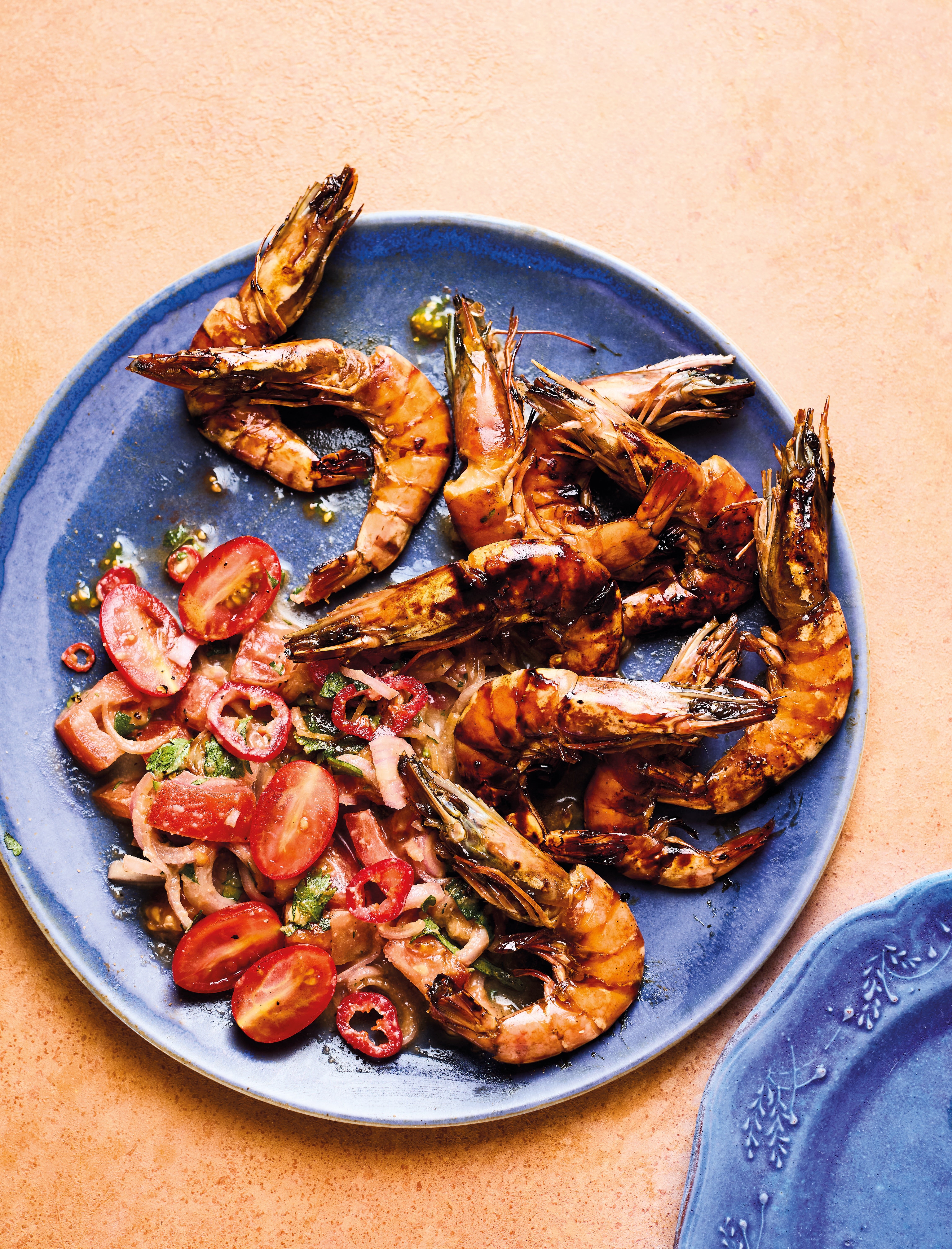
“I often make this dish for barbecues – grilled prawns are simple and delicious, but what really brings this dish to life is the tamarind relish, a recipe I learned from my grandmother,” says Saidi.
“People often ask me what the closest equivalent would be in other cuisines, and I usually say the relish is a bit like chimichurri. But it’s the addition of the pan-fried coconut butter and tamarind paste that gives it that sweet-sour depth that feels just right. Of course, the chilli adds the final kick.
“You can swap the prawns for tofu and still have a good meal, as long as you get the tamarind relish right – it’s what gives the dish its character.”
Serves: 4-6
Ingredients:
500g shell-on raw king prawns, deveined and cleaned
Juice of 2 limes
2 tbsp honey
2 tbsp sweet soy sauce (kecap manis)
1 tsp salt
1 tsp black pepper
50g unsalted butter
Seasonal salad or rice, to serve
For the tamarind relish:
2 tbsp tamarind paste
1 tbsp pan-fried coconut butter
1 tbsp honey
2 banana shallots, thinly sliced
3 tomatoes (or 16 baby plum tomatoes), roughly chopped
3 red chillies, thinly sliced
2 red bird’s eye chillies, thinly sliced
2 tbsp roughly chopped fresh coriander
Method:
1. In a bowl, mix the prawns with the lime juice, honey, sweet soy sauce and season with the salt and black pepper. Set aside to marinate for 10 minutes. Meanwhile, make the tamarind relish. Mix the tamarind paste, pan-fried coconut butter and honey in a bowl. Add the shallots, tomatoes, chillies and chopped coriander. Mix well and leave to chill in the fridge while cooking the prawns.
2. To cook the prawns, place a ridged griddle pan over a high heat. Once it begins to smoke lightly, melt the butter in the pan and arrange the prawns on the hot surface. Cook for two to three minutes, turning once, until lightly charred and just cooked through.
3. Transfer the prawns to a serving plate and generously scoop the tamarind relish. Serve with a seasonal salad or favourite rice dish.
Ayam kenduri kahwin – matrimonial chicken
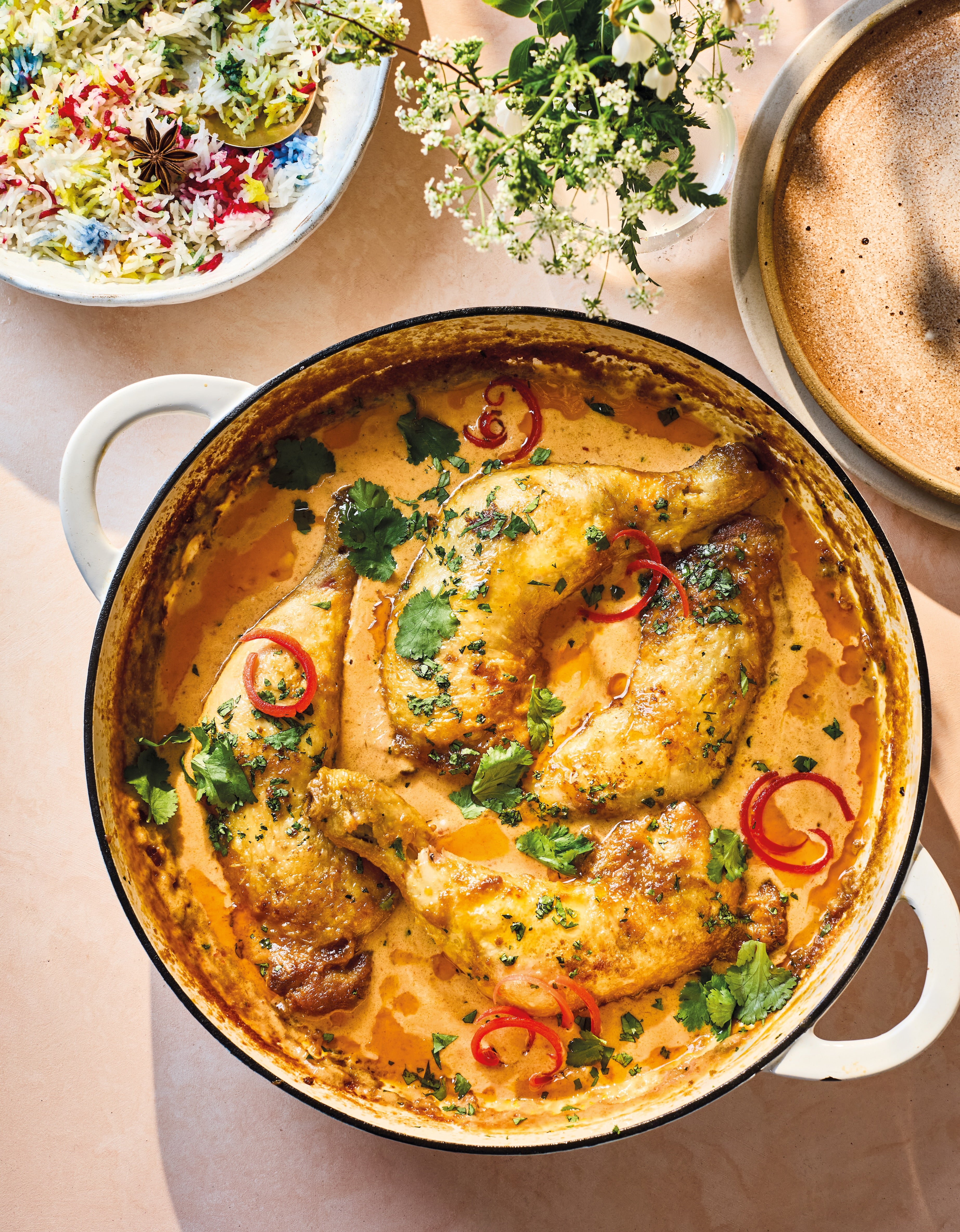
“This is my grandmother’s version of Malay ayam masak merah – chicken in a red sauce – which was always requested when she catered weddings. That’s how it came to be known as her ayam kenduri kahwin, or matrimonial chicken,” says Saidi.
“I have fond memories of watching her marinate the chicken in turmeric and salt to remove any gamey smell and to give it that warm golden glow when frying. Her version was deep-fried, but I prefer to pan-fry mine so the skin turns crisp before meeting the sauce. The sauce itself is a comforting mix of coconut milk, chilli and, yes, ketchup – which adds that tomatoey depth.
“This dish is all about balance; nothing fancy, just honest home cooking where the harmony of flavours is what makes the dish shine. Keep tasting and season it to your liking. My favourite way to enjoy this dish is with plain white rice or summer rain rice.”
Serves: 3-5
Ingredients:
4 chicken legs or 6 chicken drumsticks or 6 chicken thighs, bone in and skin on 1 tbsp ground turmeric
1 tbsp salt
30ml vegetable oil
For the sauce:
1 tbsp dried chilli flakes
120ml just-boiled water
3 banana shallots
4 garlic cloves
2.5cm/1 inch piece of fresh ginger
50ml tomato ketchup or tomato purée
400ml can coconut milk
1 tbsp sugar
1 tbsp salt
To serve:
4 tbsp roughly chopped fresh coriander
1 red chilli, finely sliced
Method:
1. Place the chicken in a large bowl and mix with the turmeric, salt and 30ml water to make a light watery paste. Set aside. In a separate bowl, soak the chilli flakes in the hot water for 10 minutes to soften. In a food processor, blend the softened chilli flakes with the soaking water and the shallots, garlic and ginger until smooth.
2. Heat the two tablespoons of oil in a large heavy-based pan (or casserole dish) over a medium heat. Working in batches, add the chicken to the pan, skin side down, and leave them to brown undisturbed for about five minutes on each side until golden. Once browned, transfer the fried chicken to a paper towel-lined plate to drain. Repeat with the remaining pieces.
3. Using the same pan, pour in the blended paste and slowly stir for about eight to 10 minutes, or until the oil separates. If the paste seems too dry, add a splash of water to loosen it. Add the tomato ketchup or purée, coconut milk, sugar, salt and two tablespoons of water. Stir and bring to a gentle boil. Taste and adjust the seasoning, if needed – you’re looking for a balance of sweet, salty, sour, creamy and the tomatoey depth of the ketchup.
4. Return the chicken to the pan. Reduce the heat to medium-low, cover with a lid and simmer for a further 15–20 minutes until the chicken is no longer pink at the bone and the juices run clear.
5. Turn off the heat, scatter with coriander and red chilli, and let rest for two to three minutes before serving.
Nasi ros buah delima – pomegranate and rose water rice
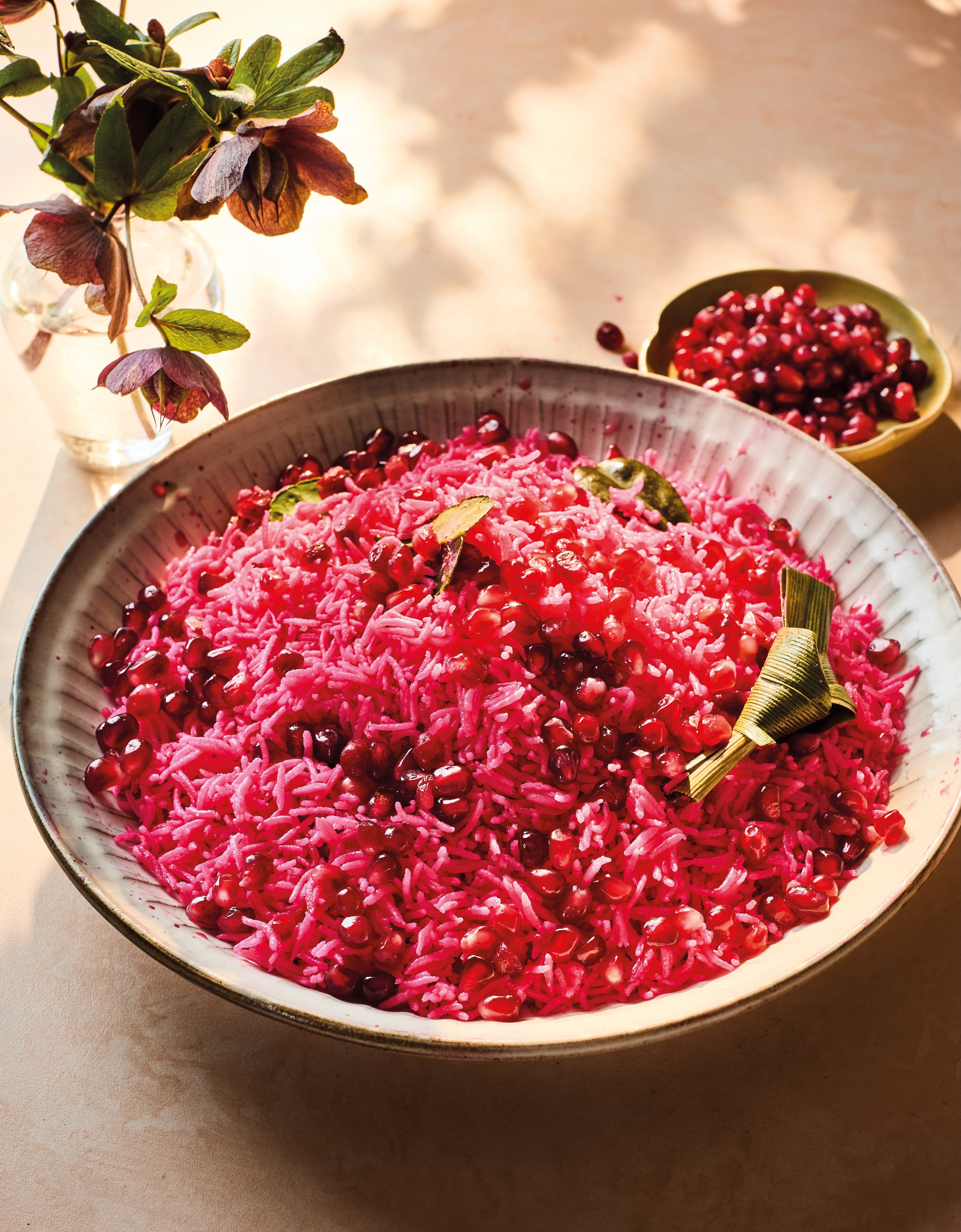
“Curry Club London, run by Matt and Pete at the old ESEA Centre in Hackney, was founded to make good food accessible to everyone. No one really knows who pays and who doesn’t, so everyone feels equal. I created this recipe for one of their community lunches,” says Saidi.
“Walking in always feels like joining a big family gathering – volunteers quietly setting up, Tash arranging seasonal flowers, Jes, Leda and Mukhta making sure every guest is looked after.
“For that lunch, I wanted something bright and festive, so I made this pomegranate and rose water rice – red, fragrant, slightly sweet and served with butternut squash coconut stew. Over time, the people I met there became my friends and the community felt like a second home. Sharing this dish felt like a true homecoming.”
Serves: 3-4
Ingredients:
300g basmati rice
250g pomegranate seeds
3 tbsp rose water
2 tsp beetroot water (or 1 tsp red food colouring)
1 pandan leaf, tied and knotted (or 1 tbsp vanilla extract)
3 makrut lime leaves
Method:
1. Rinse the rice under cold running water using a fine-mesh sieve, then let it soak in a bowl of cold water for 15-30 minutes. (This helps the grains expand and cook more evenly, resulting in a lighter, fluffier texture.) Drain the rice and set aside. Place the pomegranate seeds, rose water and beetroot water (or food colouring) in a food processor and blitz until smooth. Strain the mixture through a sieve to separate the liquids.
2. In a heavy-based pan or casserole dish, combine the rice, pandan leaf (or vanilla extract) and lime leaves with 600ml water. Stir in the blended pomegranate mixture. Bring to the boil over a medium-high heat, stirring occasionally to loosen any grains that may be sticking to the bottom.
3. Once the water is absorbed, check by pressing a spoon onto the rice – if no water rises around the spoon, cover the rice with a tight-fitting lid. Turn the heat to low and let the rice simmer for 10 minutes. Turn off the heat and let the rice sit, covered, for a further 15 minutes to complete the steaming.
4. If using a rice cooker, transfer the rice mixture to the cooker and press the ‘cook’ button. Once the rice is cooked, leave it on ‘keep warm’ for another 10 minutes to steam completely.
5. Once the rice is cooked, open the lid and remove the pandan leaf and lime leaves. Gently fluff the rice with a rice spoon or fork.
‘The Malay Cook’ by Ranie Saidi (Ryland Peters & Small, £25).