




Taiwan-born chef George Chen vividly recalls the reaction of his Los Angeles classmates in 1967 to his school lunch of braised pork and Chinese sauerkraut, served between two slices of bread.
“Oh, God, what are you eating? That’s gross,” Chen recounted during a busy lunch service at China Live, his San Francisco restaurant and bar on the edge of the nation’s oldest Chinatown.
“And now everybody wants the braised pork and Chinese sauerkraut. Hopefully, perception of Chinese (food) has now come a long way.”
The immigrant child who once felt compelled to conceal his food has since forged a reputation for delivering exquisite Chinese fine dining across the Bay Area.
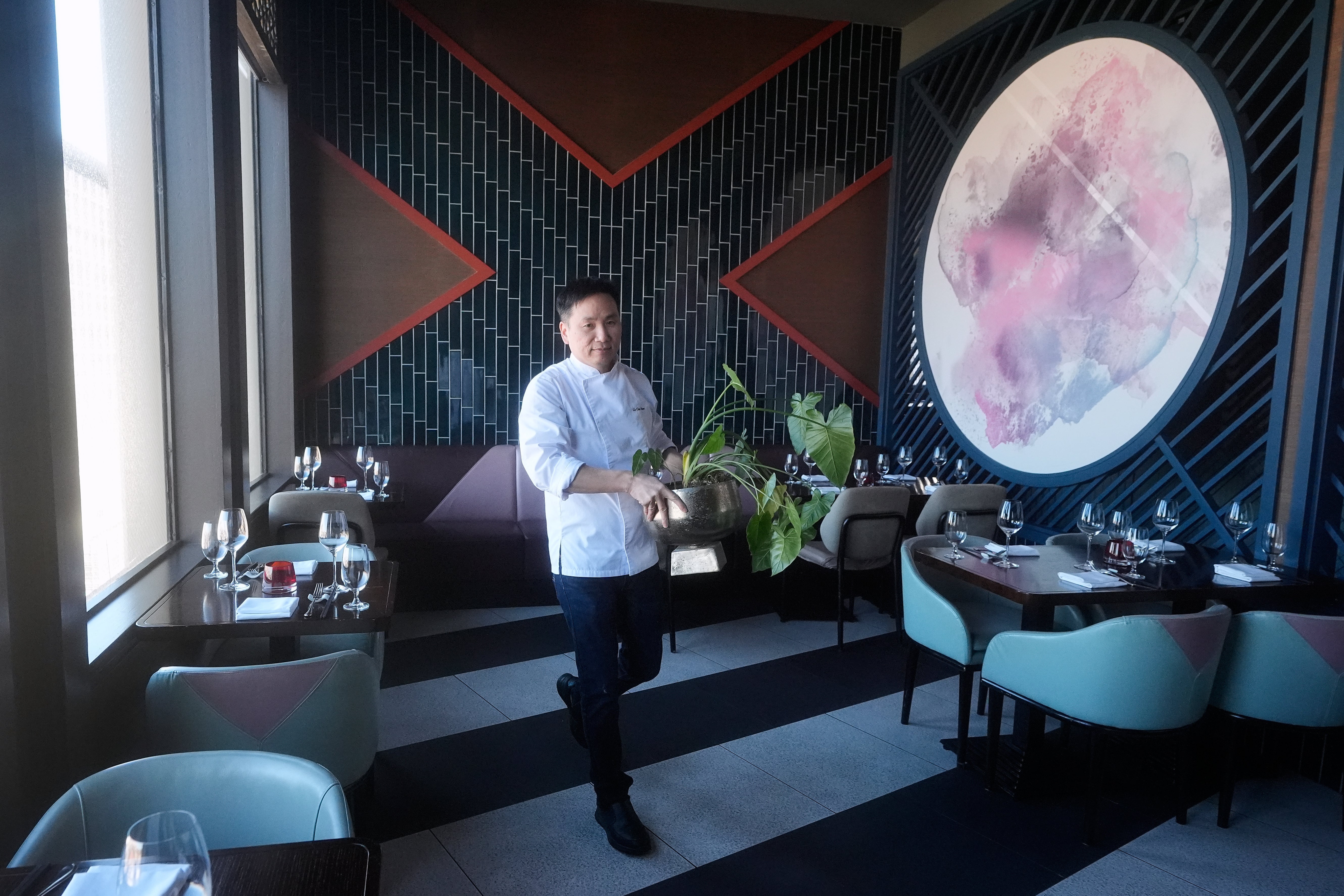
At China Live, Chen orchestrates a culinary spectacle, overseeing a bustling dumpling-making station, a stone oven roasting Peking ducks, a dedicated noodle station, and a dessert counter churning out sesame soft serve.
His ambition extends to reviving his upstairs restaurant, Eight Tables, where multi-course dinners previously ranged from $88 to $188. Furthermore, he and his wife, Cindy Wong-Chen, are preparing to launch a similar venture, Asia Live, in Santa Clara.
The Chens are not alone in their mission to elevate Chinese cuisine. Within walking distance of China Live are other established names such as Empress by Boon, Mister Jiu’s, and the newer Four Kings.
Across the United States, from San Francisco to New York City, upscale Chinese American restaurants have emerged in recent years, generating considerable interest with their refined tasting menus that transcend typical Chinese takeaway fare. Many are set to introduce special interpretations of traditional Lunar New Year dishes for the Year of the Fire Horse, which commences on Tuesday.
This creative deconstruction of Chinese foods is a hallmark of their culinary approach, as many chefs are keen to showcase their heritage.
However, in an industry where diners seldom question the high prices of French haute cuisine or Japanese omakase, Chinese restaurateurs frequently encounter resistance when asking customers to pay fine-dining prices.
Yet, these owners and chefs steadfastly maintain that their food, labour, and cooking techniques are equally deserving. “Why shouldn’t I?” Chen asserted regarding his pricing. “Just because we’re in Chinatown? Or just because people’s perception of Chinese food is that it’s only good if it’s cheap? It’s not true.”
In New York’s Hell’s Kitchen, Bolun and Linette Yao opened Yingtao in 2023, named after Bolun’s grandmother, with a clear mission: to present “contemporary” Chinese food as an elegant dining concept. Their Michelin-starred establishment offers a chef’s tasting menu priced at $150. “We are trying to break this bias, this boundary of people who only think about like Sichuan food, Cantonese food, the takeout box,” explained Bolun Yao, who holds immense respect for casual Chinese takeaway restaurants.
After completing a master’s degree in food studies at New York University, Yao was determined “to build a bridge between traditional Chinese and the fine dining scene that New York people are familiar with.” Emily Yuen, a James Beard Award semifinalist last year for her Japanese American cuisine at Brooklyn’s Lingo, is now helping Yao achieve this goal as Yingtao’s new executive chef. For Yuen, a Chinese Canadian whose culinary training heavily featured French cooking, the significance of representation – from the kitchen staff to the dishes on the plate – has always resonated deeply. “I want go back to like, who I am, and kind of explore that,” Yuen stated. “I was really like struck by his (Bolun’s) mission statement and it just really struck a chord with me of wanting to elevate Chinese culture and Chinese food.” She is eager to experiment with classic recipes, such as the Cantonese custard egg tart, “dan tat,” giving it a savoury twist with caviar and quail eggs. “Egg on egg on egg,” Yuen quipped.
Similarly, Ho Chee Boon, the Michelin-starred chef who transformed San Francisco’s long-dormant Empress of China into Empress by Boon in 2021, is advocating for Chinese cuisine to be recognised as fine dining in the U.S. The Malaysia-born restaurateur was accustomed to seeing high-end Cantonese food in China and India. “I try to do something for the Cantonese cuisine and for the culture as well, for the young people and to know about and for other people to know about it,” said Boon, who has established a chain of his Cantonese Hakkasan restaurants from Dubai to Mumbai and in the U.S. “We can try to something better here,” he added, “and let people come back to Chinatown.”
Chinese culture and food have experienced a fluctuating reception in the West. More than two centuries ago, Europe highly coveted Chinese silks, ceramics, and tea, according to Krishnendu Ray, director of NYU’s food studies PhD programme. However, China’s defeat by the British in the 19th-century Opium Wars led to a perception of China “as a poor country,” Ray noted. Racist myths portraying Chinese people and their cuisine as strange and unclean persisted when Chinese railway labourers arrived in the U.S. and were segregated into enclaves. Even today, Asian American restaurants continue to be affected by outdated stereotypes.
Ray suggests that the rise in prestige of an “ethnic” food often correlates with its country of origin’s increasing economic power. In Michelin’s New York City guides, which feature between 300 and 400 restaurants, Ray observed that the percentage of Chinese regional cuisine mentions increased from 3% to 7% between 2006 and 2024. “I think it’s wonderful that there are these restaurants now” in Chinatown, commented Luke Tsai, food editor for the San Francisco Bay Area PBS station KQED. “It’s fine also if you don’t think it is worth it. But at the same time, I’m really glad that these restaurants exist.”
Many Chinese chefs are keen to clarify that they are not serving “fusion” cuisine, or food merely tinged with Asian influences. Their culinary approach is “more East to West rather than West to East,” stated Chen of China Live. Yuen of Yingtao concurs, suggesting that such characterisation often leads to “fusion” becoming “confusion.” “I think fusion food is in a lot of those places where it’s dimly lit with the trendy cocktails,” Yuen said. “What we’re trying to do is just Chinese.”
Crucially, these chefs prioritise incorporating traditional Chinese cooking techniques rather than defaulting to European methods. At Empress by Boon, chef Boon and his team maintain four wok stations, equipped with woks shipped directly from Hong Kong. “We want to do exactly everything the same operation,” Boon explained. “We want to keep the traditional, but we can look in a modern way.” Chen takes pride in his open kitchen, where customers can observe woks and clay pots in use, representing techniques from various regions of China. “You actually look at the greater culinary disciplines of China and because you have the space, you can showcase the cuisine,” Chen concluded. “I think that’s really served us well.”