




For years now, Amazon has been depicted as the “ultimate green hell.” The favourite explorer stories and textbooks always described it as an endless wilderness, which had huge civilisations that disappeared into thin air. People were made to believe that it was a land that had poor soil, while the forest cover was so thick and dense that only small nomadic tribes could survive in the area. However, it seems like the picture people held about Amazon is changing with a ray of light shining through. With the use of laser technology by archaeologists, it appears that there are a number of connected urban centres that exist in the region.The discovery does not consist of the sudden realisation of finding a few long-lost ruins buried deep within the earth. This is a reimagining of humanity’s past. These monuments weren’t really lost, per se; they were concealed by a forest that kept such well-guarded secrets. An enormous earthen pyramid, for example, looks like nothing more than a natural hill to the naked eye, while an ancient superhighway appears like nothing more than an indentation in the floor of a jungle. It took Lidar technology to reveal the razor-sharp geometric perfection of a civilisation that once held sway over the greatest rainforest in the world.Stripping back the greens: The laser that discovered an empireFor any Amazon explorers, the main difficulty lies in what they can see. The canopy is so dense that one could be standing directly in front of a massive stone wall and not even know it. The arrival of Lidar transformed the situation by firing millions of laser pulses from a plane to create a three-dimensional representation of the ground below. By digitally stripping away the jungle, scientists have gained unprecedented insight into the very bones of the landscape.The groundbreaking study titled Lidar Unearths Pre-Hispanic Low-Density Urbanism in Bolivia’s Amazon Basin provided the proof for this hidden world. With a focus on the Casarabe civilisation, archaeologists discovered a well-planned settlement which amazed the academic community. They mapped out huge platform structures, 22-meter-high pyramids, and an extensive canal system. It was not simply a group of scattered, rudimentary settlements. It was a highly sophisticated civilisation capable of managing its environment in an impressive manner.This information helps us to see a picture of a vibrant past for the Amazon, one which was buzzing with life and activity. Whereas other civilisations have been known to construct their societies within enclosed, high-density city spaces, such as those made out of stone during prehistoric times, the people here used a low-density approach. This saw houses and other amenities placed separately and connected by a raised road system. This ensured that while many people could occupy a relatively small space without upsetting the delicate ecological balance of the rainforest.
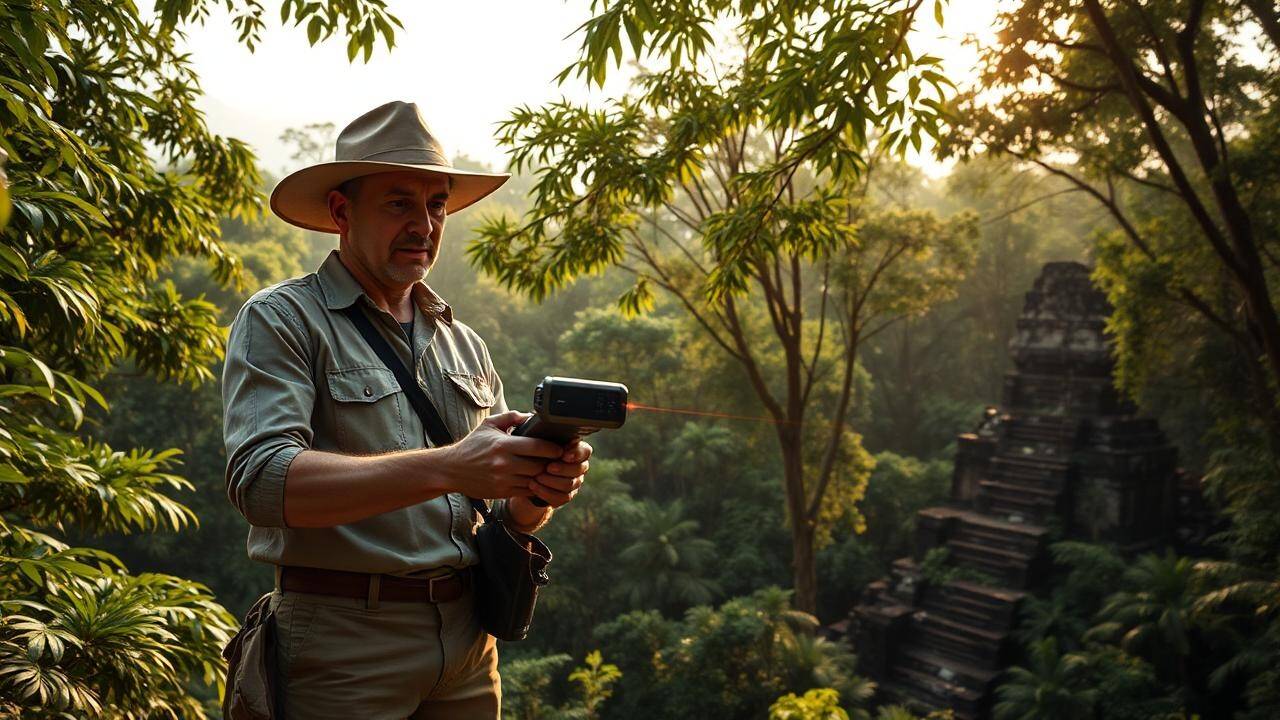
Archaeologists have uncovered evidence of a low-density, interconnected civilization that masterfully managed its environment, fundamentally altering our understanding of human history in the region.
Connected continents: Networks across the jungleAs more evidence emerges, there is an emerging understanding that these communities were actually part of an engineering practice that was widespread across the entire continent.According to a study in Nature Communications, the human footprint here was massive. Archaeologists identified over 80 sites and hundreds of individual earthworks along the southern edge of the forest. This indicates that a huge stretch of the Amazon, once thought to be a vacuum, was actually a “string” of interconnected communities. These groups built fortified villages and shared a common building style, suggesting they were in constant communication.The excitement generated by such discoveries is continuing to mount in 2026. As recently reported by the University of Missouri, one such excursion, conducted by Daniel Pierce and Christopher Bodine, returned from the Brazilian Amazon with newly acquired LiDAR data indicating many geoglyphs – massive geometric designs etched into the landscape from deep within the jungle. Although their significance remains unknown at this time, they add yet another layer to the growing evidence that what we know about the rainforest is only scratching the surface.A whole new perspective alters our notion of how humans interact with nature. The Amazon Rainforest is not an unspoiled wilderness but rather a cultural parkland shaped by man’s intervention through the years. They are all still there, obscured yet guarded by the very same forest that has taken them back from us. With each scan by Lidar, we are literally writing history anew, pixel by pixel, beam by beam.