




Concepts that lead to change don’t always have to arise from sophisticated laboratories or countless research grants. At times, these ideas can arise from within the crucible of personal pressures, as an individual fights to remain afloat. This was exactly the situation that faced a nineteenth-century machinist by the name of Walter Hunt, who found himself burdened by a debt of fifteen dollars and a brass wire. As he sat at his workbench and bent this piece of metal, struggling to think about money, he inadvertently invented one of the greatest inventions in man’s history.Straight pins are such a mundane part of modern life that we seldom wonder about their origins. We pick one up to mend a frayed hemline, fasten a baby’s diaper, or hold a runner’s number tag, but before Hunt’s spontaneous day’s work, straight pins had a tendency to jab into the skin or fall out. His invention created a sense of security and functionality that stemmed from the desire to pay back a debt. It is the classic story of an inventor rising up to tackle a common problem.The engineering behind a payback-inspired creationWhile the fifteen-dollar debt has become the stuff of innovation legend, the actual engineering innovation was indeed tangible. The Lemelson-MIT website biography of Walter Hunt explains that it took Hunt around three hours to design a mechanism using a single piece of wire that featured a spring and a locking mechanism. The spring component of the pin became the revolutionary aspect because it provided sufficient pressure to keep the pin closed, while the tip’s “shield” or catch mechanism prevented injury from the pointed end.One is surprised by how it never occurred to Hunt that he was trying to revolutionise the fasteners industry. After all, Hunt was only a desperate man who had run out of time and was basically broke at the moment. One finds in the article that similar clasps were already being used since as early as 1842; the only difference was that they lacked the vital spring which gave Hunt’s version an edge over its competitors. Just one additional spring turned Hunt’s crude invention into something of a modern marvel. He had a gift for hardware inventions, enough to recognise potential in scraps of metal and develop them to solve pressing problems of everyday life.
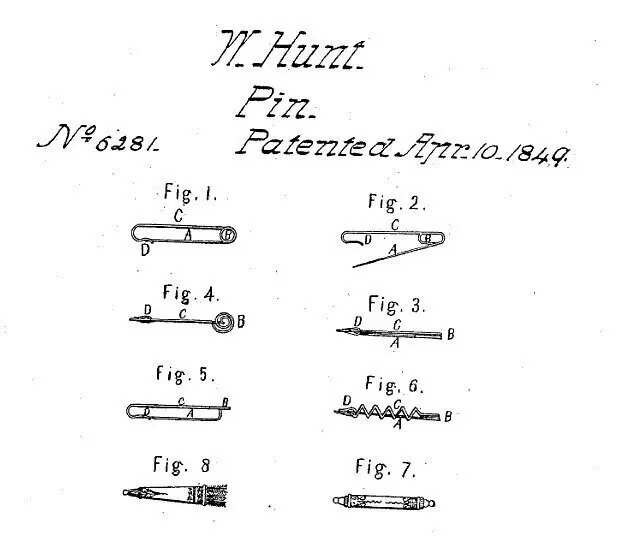
Though Hunt sold the patent for a quick profit, his simple yet effective creation became a mass-produced marvel, impacting everyday life and even evolving into a cultural symbol. Image credit: U.S. Patent Office, via Wikimedia Commons
There lies the contradiction in Hunt’s character. Although he came up with innovative ideas, it seemed that he lacked the persistence needed to develop them properly. An inventor-for-hire who was quick to jump on any idea, Hunt created such gadgets as a fountain pen, a knife sharpener, and even tried to design an earlier version of the sewing machine. But Hunt is known for the safety pin because of its ability to be mass-produced – small, affordable, and solving the needs of everyone, from queens to commoners.A quick paycheck or worldwide hitThe economic history of the safety pin says much about how ideas were traded during those times. Not having founded a factory after receiving the patent or establishing any company under the name of W. J. Hunt, the man kept his word by using money received from selling his invention to repay his debt and give him a new lease on life. According to the study Economic Growth and the Market for Ideas published by the University of Rochester, Hunt’s safety pin patent cost only four hundred dollars but promised to bring millions of profit in the following years.This separation between the inventor and the eventual owner is a common theme in the history of technology. The study uses this specific case to show how innovation often happens with one person, while the commercial success belongs to another. Hunt provided the design, but the manufacturers who came after him provided the scale. They turned his three-hour wire twist into a mass market item that crossed borders and cultures. Because the design was so simple and the mechanism so sturdy, it disappeared into the background of ordinary life, becoming an object so familiar that we often forget it was ever “invented” at all.In today’s world, the safety pin has transcended its utilitarian nature to become an icon of punk rock rebellion and a symbol of unity in various movements. It outlives almost all other inventions from 1849. Despite Hunt not having left any fortune behind, his ability to solve a mechanical problem on a whim during a crisis has altered how society functions. This story serves as an inspiration for people to understand that, despite their dire circumstances, the innovations they create to sustain themselves could serve to benefit others.