




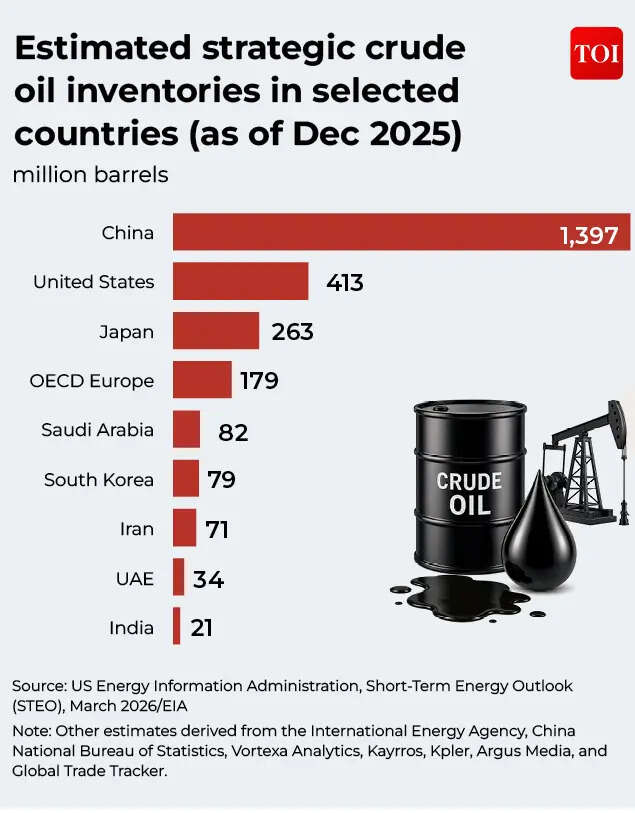
Did you know that China holds the largest strategic oil reserves in the world? Amid ongoing disruptions due to the US-Iran war and blockade of the Strait of Hormuz, this fact assumes significance. Which is not to say that the world’s second largest economy is not dependent on the Middle East to meet its massive oil and energy needs. The United States of America, which is the largest producer of oil, holds the second largest strategic oil reserves, followed by Japan, according to the US Energy Information Administration’s (IEA) data analysis for December 2025.During the 1970s, the United States and other members of the OECD created strategic petroleum reserves to cushion their economies against disruptions in oil supply. In March 2026, after the Strait of Hormuz was effectively shut, the United States and fellow members of the International Energy Agency jointly agreed to release emergency crude supplies from these reserves.Based on current estimates, the largest strategic crude reserves at the end of December 2025 were held by China, which significantly expanded its holdings during 2025. Substantial strategic stockpiles are also maintained across OECD Europe, as well as in parts of the Middle East and Asia, the IEA analysis says.Because many countries do not publicly disclose detailed data on their strategic oil reserves, these estimates have been prepared by IEA using a cautious methodology. For nations that do not maintain a formally designated strategic petroleum reserve, strategic inventories are defined as oil held by governments or national oil companies. In certain cases, only onshore storage volumes are included.The assessment excludes inventories stored in commercial facilities, offshore tankers, or underground storage sites. China is the sole exception, where commercial inventories are also counted as part of strategic reserves. Similarly, although some countries, including Japan, require private companies to maintain oil stocks for emergency purposes, only government-owned reserves or inventories held by state-owned national oil companies are included in these estimates.The analysis focuses on the 10 countries with the largest estimated strategic oil reserves and onshore storage capacity. Together, these nations account for roughly 70 per cent of total global strategic oil holdings.
China
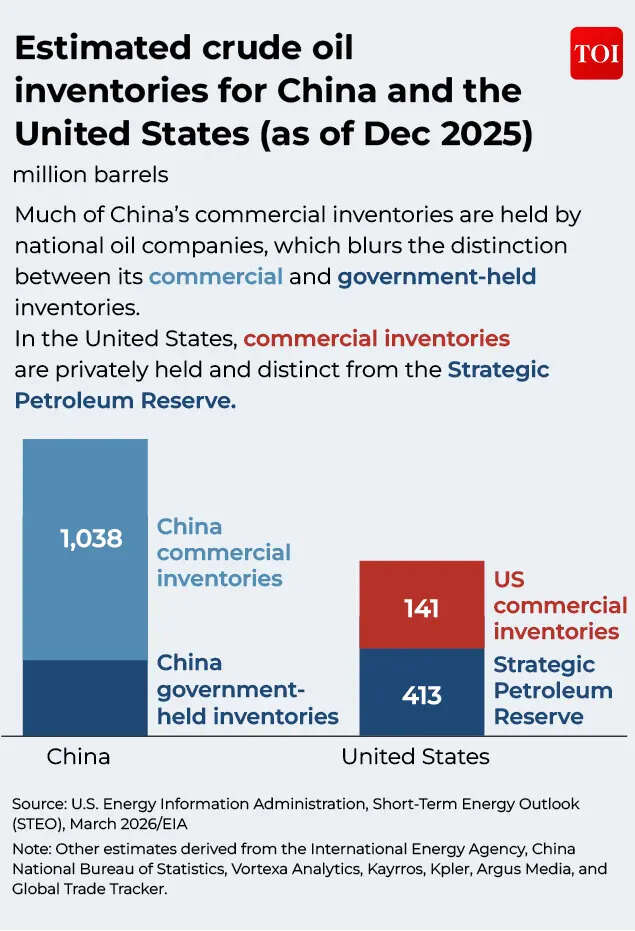
China significantly expanded its strategic crude reserves in 2025. IEA estimates that the country added crude at an average rate of 1.1 million barrels per day during the year, taking total strategic oil inventories to nearly 1.4 billion barrels by December 2025.Preliminary official data suggest that China continued to build its oil stockpiles in 2026, even before the conflict involving Iran escalated.It’s noteworthy to know that China does not publicly disclose its oil inventory figures. Hence, IEA has derived the numbers using import, export, refining, and stock data from both official and third-party sources.IEA has included both government-owned and commercial crude inventories in China as strategic reserves.Government-controlled crude reserves in China are estimated to have averaged roughly 360 million barrels in December 2025.
United States of America
The US established its Strategic Petroleum Reserve (SPR) in December 1975. The reserve has a maximum storage capacity of 714 million barrels of crude oil. By December 2025, holdings in the SPR stood at 413 million barrels.Inventory levels rose further to more than 415 million barrels in March 2026, just before the coordinated emergency release. As of April 10, 2026, stocks had eased to around 409 million barrels.The SPR is distinct from the country’s commercial crude inventories, which are more than 400 million barrels.
OECD Asia and Europe
Japan has the world’s third-largest strategic petroleum reserves, with government-owned stockpiles totaling 263 million barrels as of December 2025. This figure excludes oil held under international joint stockpiling arrangements, as well as commercial inventories maintained for emergency use under Japanese regulations.Under Japan’s Oil Stockpiling Act, private industry is required to maintain reserves equivalent to 70 days of domestic demand, or roughly 220 million barrels. This is separate from the government-managed strategic reserve, which covers an additional 90 days of demand.According to the IEA, countries in OECD Europe collectively held around 179 million barrels in government-owned strategic oil reserves as of December 2025.South Korea also maintained sizable strategic crude stockpiles, averaging 79 million barrels during the same period.
Other Non-OECD Countries
Outside the OECD, estimating strategic oil inventories is a challenge. With the exception of India, reliable figures for countries such as Saudi Arabia, the United Arab Emirates, and Iran are not available.Estimates for Saudi Arabia, the UAE, and Iran are based on average refinery and commercial stock levels for December 2025, as reported by Vortexa and Kpler.Saudi Arabia is estimated to have held an average of 82 million barrels in onshore storage at the end of December 2025. This estimate excludes crude reportedly stored at leased facilities overseas, including sites in South Korea as well as the Okinawa and Kiire terminals in Japan.The United Arab Emirates held an estimated 34 million barrels of onshore oil inventories during the same period. In addition, the UAE operates substantial underground storage facilities in Fujairah, although the exact capacity and current stock levels there are not publicly known. The country is also reportedly working to expand storage capacity at that location.Beyond its domestic storage, the UAE is understood to lease additional capacity at the Yeosu port in South Korea, the Kiire terminal in Japan, and the Mangalore storage facility in India.Iran is estimated to have maintained an average of 71 million barrels of onshore oil inventories as of December 2025. Although Iran is also believed to store crude in bonded facilities in China, current stock levels at those locations are not publicly available and are therefore excluded from this estimate.
Where does India stand?
According to Indian Strategic Petroleum Reserves Limited, India held 21.4 million barrels of crude oil in its strategic petroleum reserves as of March 2025.In addition, around 3 million barrels of crude were stored at India’s Mangalore facility on behalf of the Abu Dhabi National Oil Company. These volumes are not counted as part of India’s strategic reserves.Under the agreement between ADNOC and Indian Strategic Petroleum Reserves Limited, ADNOC is permitted to use the Mangalore facility for commercial storage. However, half of the site’s total capacity, which is roughly 6 million barrels, must remain available for strategic use by ISPRL whenever required.India has also been evaluating options to expand its storage footprint beyond its borders. As part of these efforts, it held discussions with Oman last year regarding the possibility of leasing storage space for up to 5 million barrels of crude oil.