




Last Updated:
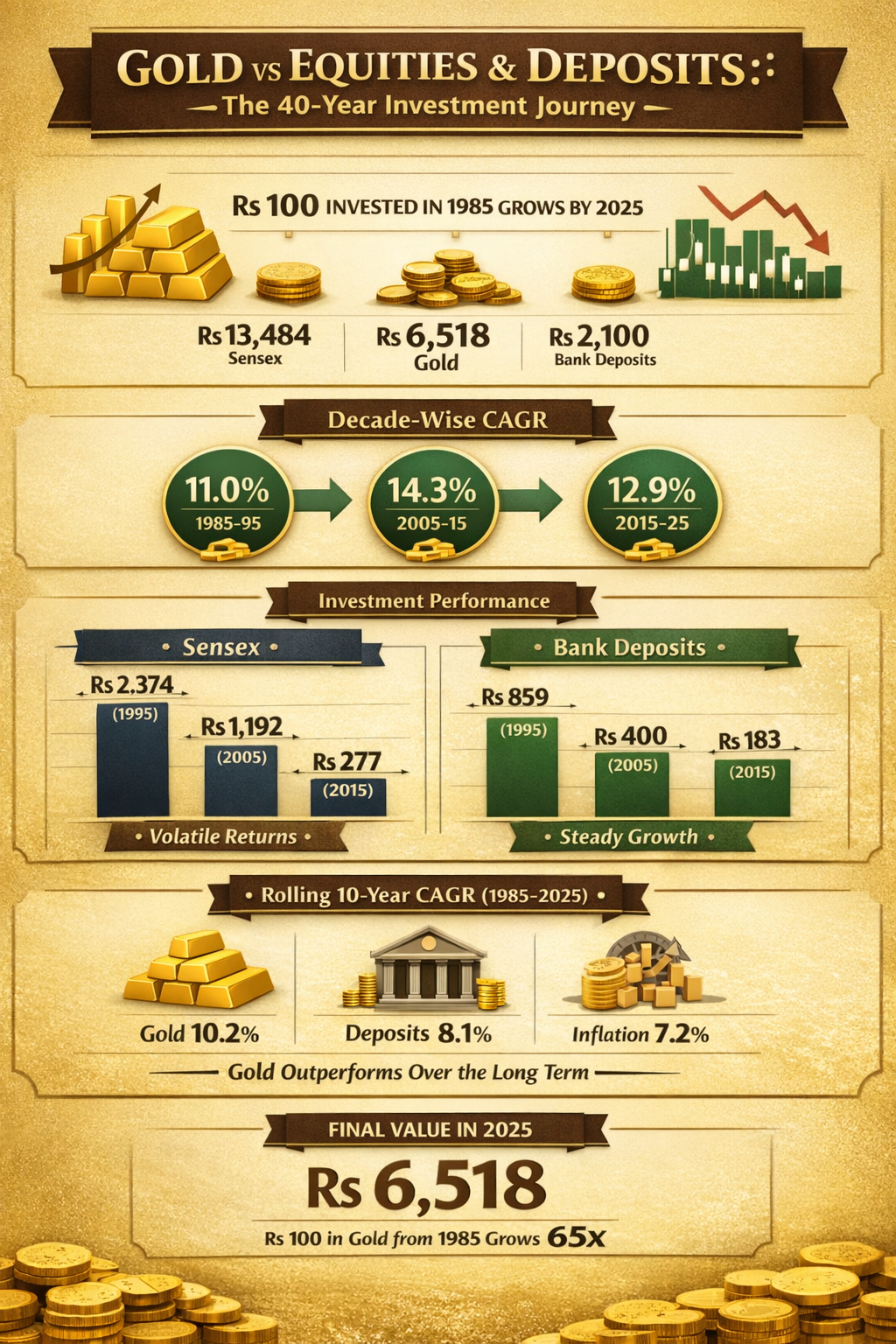
Since 1985, gold’s average 10-year rolling CAGR of 10.2% has consistently beaten bank deposits (8.1%) and inflation (7.2%)
Gold
Gold Price Trend: Gold prices moved higher on Wednesday, December 17, supported by firm global cues and rising expectations of further US Federal Reserve rate cuts after data showed an uptick in US unemployment in November. On the MCX, February gold contracts advanced 0.55% to trade at Rs 1,35,150 per 10 grams, staying just below the previous session’s record high of Rs 1,35,346.
Market participants said the move reinforces gold’s traditional role as a safe-haven during periods of economic uncertainty. “Gold continues to act as a stabiliser whenever markets anticipate policy easing or face macro stress,” an analyst tracking bullion markets noted.
Gold’s Compounding Power Over Four Decades
A report by WhiteOak Capital highlights gold’s effectiveness as a hedge against volatility and inflation for nearly four decades. The analysis shows that gold not only cushioned portfolios during years when domestic equities delivered negative returns but also generated competitive long-term gains, reinforcing its role in multi-asset allocation strategies.
An investment of Rs 100 in gold in 1985 would have grown to Rs 6,518 by March 2025, significantly outperforming bank deposits, which rose to Rs 2,100, and the inflation-adjusted value of Rs 1,478. While the BSE Sensex climbed to Rs 13,484 over the same period, equities achieved this with far higher volatility, whereas gold delivered steadier compounding and downside protection during turbulent market phases.
Gold vs Equities vs Deposits: Period-Wise Comparison
The report shows that equities also underperformed gold in certain entry periods. For instance, Rs 100 invested in the Sensex would be worth Rs 2,374 (1995), Rs 1,192 (2005) and just Rs 277 (2015).
Bank deposits grew steadily but modestly: Rs 100 became Rs 859 (1995), Rs 400 (2005) and Rs 183 (2015), reflecting their low-risk, low-return nature. Inflation-adjusted values—Rs 656 (1995), Rs 355 (2005) and Rs 161 (2015)—underline how real wealth creation remains limited without asset allocation.
Decade-Wise Returns Highlight Cyclical Resilience
Gold’s decade-wise performance underscores its resilience across economic cycles. The metal delivered an 11.0% CAGR in the decade starting 1985, accelerated to 14.3% in the decade beginning 2005, and maintained a strong 12.9% CAGR in the decade from 2015, highlighting its sustained appeal across varying macro environments.
Rolling return data adds further support. Since 1985, gold’s average 10-year rolling CAGR of 10.2% has consistently beaten bank deposits (8.1%) and inflation (7.2%), reinforcing its long-term strength.
Gold Price Trend: A Counter-Cyclical Asset
Financial-year-wise index performance in the report confirms gold’s counter-cyclical nature. In several years when domestic equities posted negative returns, gold delivered strong gains, providing meaningful downside protection and helping smooth portfolio volatility.
From FY2011 to FYTD 2026, gold generated a 13.9% CAGR, making it the second-best performer among tracked asset classes, behind only the S&P 500 TRI (INR). This track record shows that gold has offered not just safety, but also competitive risk-adjusted returns.
While the BSE Sensex recorded strong gains in years such as FY2014 and FY2015, it also saw sharp declines, including –9.2% in FY2012, –18.5% in FY2017 and –22.9% in FY2020. In contrast, MCX Gold provided a hedge, delivering positive returns during equity drawdowns, including 32.9% in FY2012 and 29.7% in FY2020. The S&P 500 TRI (INR) led all major assets with a 19.2% CAGR over the same period, while gold maintained a solid 13.9% CAGR and short-term bonds stayed stable at 7.7% CAGR.
Reiterating the compounding impact, the report again notes that Rs 100 invested in gold in 1985 would now be worth Rs 6,518, far surpassing inflation-adjusted holdings and significantly narrowing the gap with equities over time despite much lower drawdowns. These comparisons reinforce gold’s dual role as both a growth asset and a risk-mitigating investment.
Gold Outlook: Technical View
On the technical front, analysts expect gold prices to remain range-bound in the near term. “Gold is expected to trade around $4,300 (approximately Rs 1,33,000) on dips near support, with profit-booking likely close to resistance,” said Renisha Chainani, Head – Research at Augmont. She added that sustained global uncertainty and anticipated policy action by the US Federal Reserve are likely to continue supporting bullion prices.
 Click here to add News18 as your preferred news source on Google.
 December 17, 2025, 14:57 IST
Read More